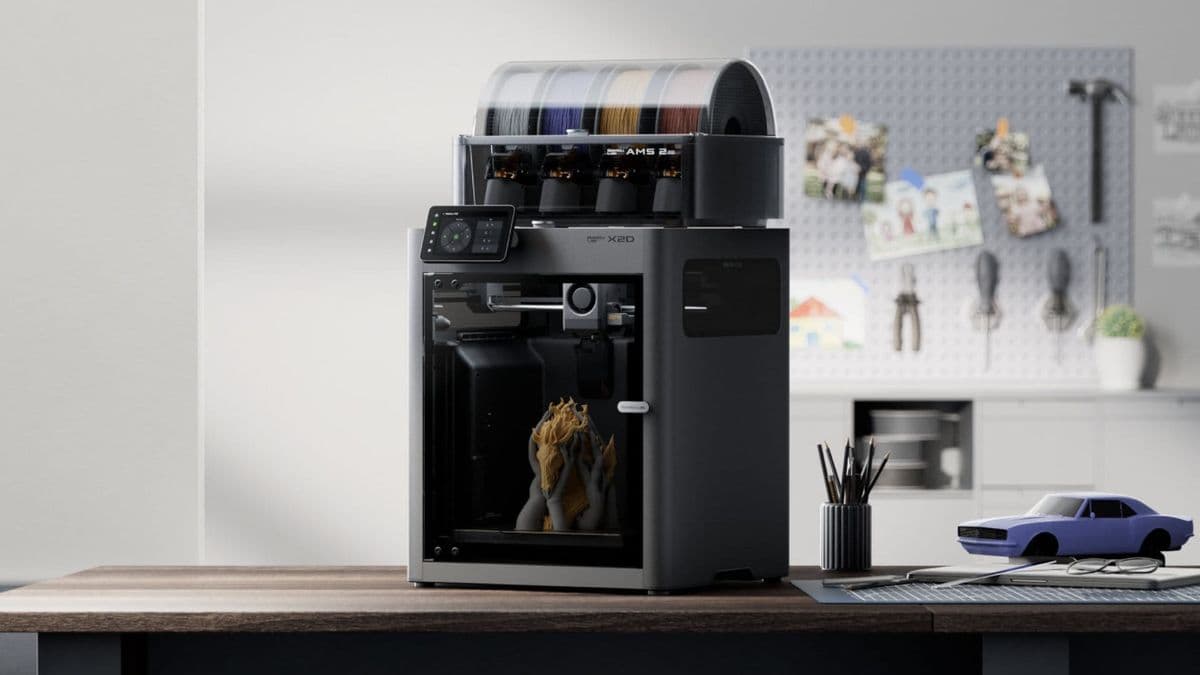
Bambu Lab X2D
- Price
- $649
- Score
- 8.8/10
- Wins
- 5/5
Specs and US prices from the PrintPick catalog, checked 2026-09-29. Scores are PrintPick ratings out of 10.
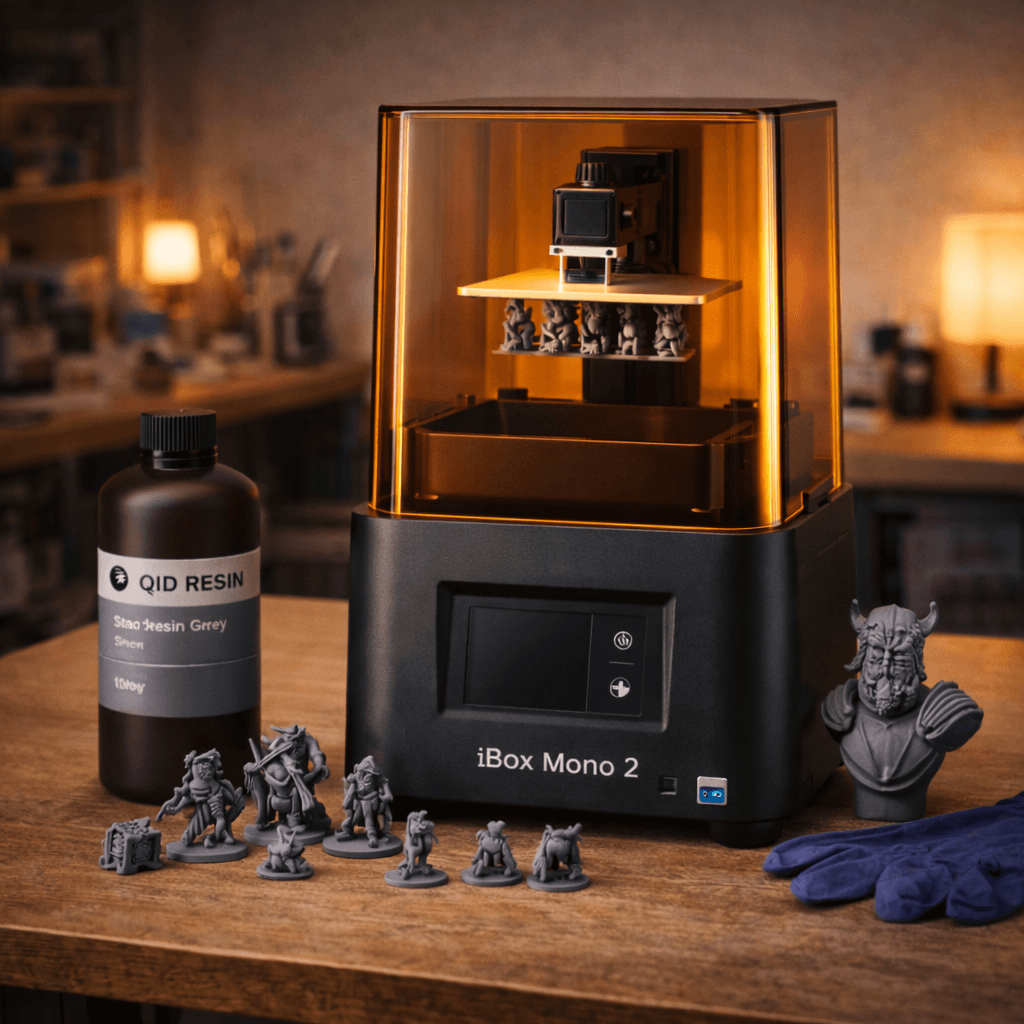
Buy the X2D.
8.8/10 vs iBox Mono2's 6.4/10, and it wins 5 of 5 categories. At $649 the X2D kills the gap that used to exist between the P2S and the H2D. For $100 more than a P2S you get dual nozzles, active chamber heating, and a servo extruder with flow sensing. The $899 Combo is the sweet spot for serious hobbyists. Most aggressively priced printer launch of 2026.
Teal wins the row.
| X2D | Spec | iBox Mono2 |
|---|---|---|
| $649 | Price | $229 (wins) |
| 17.0 L (wins) | Build volume | 1.6 L |
| 600 mm/s | Top speed | 90 mm/s |
| 0.05 mm | Finest layer | 0.01 mm (wins) |
| 22 kg | Weight | 5.2 kg |
| X2D | Feature | iBox Mono2 |
|---|---|---|
| Yes | Dual extruder (direct drive + bowden) | No |
| Yes | 65C actively heated chamber | No |
| Yes | 300C hotend with servo extruder and real-time flow sensing | No |
| Yes | Optional Vision Encoder (50-micron motion accuracy) | No |
| Yes | 31 sensors monitoring feed path, thermals, and safety | No |
| Yes | AI camera with failure detection | No |
| Yes | AMS 2 Pro compatible | No |
| Yes | Stainless steel linear rails | No |
| Yes | 3-stage air filtration (G3 + H12 HEPA + activated carbon) | No |
| Yes | Sub-50dB noise level | No |
| No | 4K mono LCD | Yes |
| No | Enclosed design | Yes |
| No | WiFi | Yes |
| No | Compact form factor | Yes |
$649 ÷ 17.0 L and $229 ÷ 1.6 L. Lower is more printer for the money.
| X2D | Spec | iBox Mono2 |
|---|---|---|
| $38.09 (wins) | $ per liter | $140.32 |
| X2D | Spec | iBox Mono2 |
|---|---|---|
| 8 (wins) | Value | 7 |
| 7 (wins) | Beginner Friendliness | 6 |
| 10 (wins) | Print Quality | 7 |
| 10 (wins) | Speed | 5 |
| 9 (wins) | Reliability | 7 |
| 8.8 (wins) | Overall | 6.4 |
Exceptional print quality, material compatibility, and all at a superb price.X2D owner, TechRadar
Improving a fan favorite. The X2D delivers where it counts.X2D owner, Tom's Hardware
The enclosed design is the killer feature. My apartment doesn't smell like a resin factory anymore.iBox Mono2 owner, r/resinprinting
Niche pick, but if you share a small space, the enclosure is worth it.iBox Mono2 owner, r/PrintedMinis
A printer does nothing without these. Grab them in the same order.
A printer does nothing without these. Grab them in the same order.
By the numbers, the Bambu Lab X2D scores higher (8.8/10). But "better" depends on your use case, the QIDI iBox Mono2 may be the smarter buy if you need resin.
The Bambu Lab X2D is more beginner-friendly (7/10 vs 6/10) with easier setup and a gentler learning curve.
The Bambu Lab X2D scores higher overall (8.8/10 vs 6.4/10). The extra $420 gets you dual nozzle at $649, a third of what the h2d costs.
Technology: the Bambu Lab X2D is FDM (filament) and the QIDI iBox Mono2 is RESIN (resin). FDM prints bigger functional parts; resin delivers finer surface detail.