Bambu Lab X2D: Full Specs, Price, and What You Need to Know
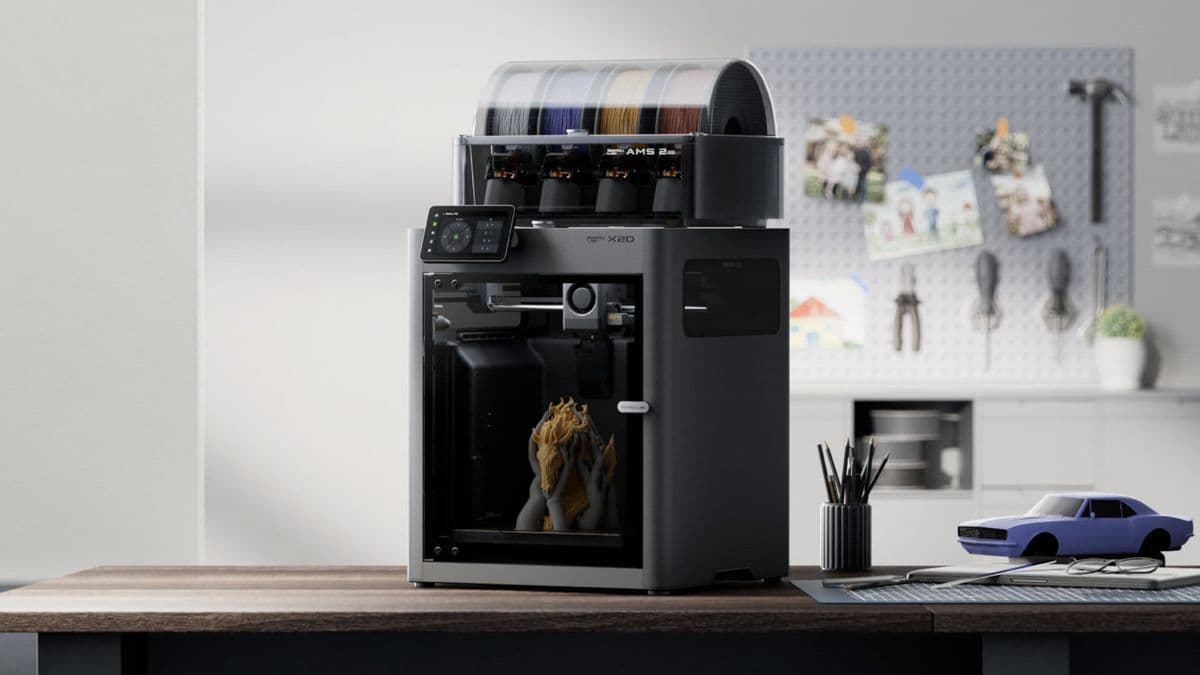
The successor to the X1 Carbon is here. Dual nozzles, 65C heated chamber, servo extruder with real-time flow sensing, and a $649 price that undercuts the H2D by two-thirds.
Top pick in this guide
Bambu Lab X2D
$649, PrintPick score 8.8/10. Check the live price before it moves.
Bambu Lab X2D
Confirmed Specs and Features, Score: 8.8/10, $649
The X2D packs dual nozzles (a direct drive primary and a bowden secondary with motor mounted at the rear), a 65C actively heated chamber, a 300C hotend with servo extruder featuring real-time flow sensing, and stainless steel linear rails (replacing the X1 Carbon's carbon fiber rods). The build volume is 256x256x260mm in single-nozzle mode, reduced to 235.5x256x256mm in the dual-nozzle intersection zone. 31 sensors monitor the feeding path, thermal environment, and safety. The PMSM motor samples torque and position 20,000 times per second. An optional Vision Encoder delivers 50-micron-class motion accuracy. The AI camera with spaghetti detection returns, and the X2D is compatible with the AMS 2 Pro for up to 25-color printing. The 3-stage air filtration system (G3 pre-filter, H12 HEPA, and coconut shell activated carbon) keeps the workspace clean, and the sub-50dB noise level makes it one of the quietest enclosed printers available. The dual nozzle system is the headline feature. By mixing two filaments that do not stick to each other, supports peel off cleanly without scarring the model surface. This eliminates the tedious support removal process and enables geometries that are impossible with single-nozzle printers. Bringing this feature down from $1,899 (H2D) to $649 makes it accessible to hobbyists, not just prosumers. The 65C heated chamber means the X2D handles every engineering filament: ABS, ASA, Nylon, PC, PA-CF. The P2S tops out around 45-50C passively, which limits its engineering material capabilities. For anyone printing functional parts in demanding materials, the X2D's active chamber heating is a significant upgrade. Pricing: $649 standalone (US), $899 with AMS 2 Pro Combo. It is the best value in the enclosed dual-nozzle category by a massive margin.
Bambu Lab P2S
X2D vs P2S: Is the Upgrade Worth It?, Score: 9.2/10, $549
The P2S ($549) and X2D ($649) share a similar build volume and speed class, but the differences matter for specific use cases. The X2D adds dual nozzles, active chamber heating to 65C, a servo extruder with real-time flow sensing, 31 sensors, and optional Vision Encoder. The P2S has the quick-swap nozzle system (single nozzle) and the same 1080p AI camera. For PLA and PETG printing, the P2S is all you need. The dual nozzles and heated chamber on the X2D are overkill if you are printing figurines, decorative items, or basic functional parts. The P2S's quick-swap nozzle system is arguably more useful for day-to-day printing than dual nozzles. Where the X2D pulls ahead: engineering materials (ABS, Nylon, PC, carbon fiber composites) and complex prints that benefit from soluble support material. If you print functional parts for automotive, aerospace, or industrial prototyping, the X2D's heated chamber and dual nozzles save hours of post-processing per week. The price gap is just $100. That makes the X2D an almost automatic upgrade for anyone considering the P2S who works with engineering materials. For hobbyists printing only PLA, the P2S still wins on value. For everyone else, the extra $100 for dual nozzles and a 65C chamber is the easiest upgrade decision in 3D printing.

Bambu Lab H2D
X2D vs H2D: Do You Need the Flagship?, Score: 8.2/10, $1899
The H2D ($1,899 base, up to $3,799 with laser) and X2D ($649) share dual nozzles and a 65C heated chamber. The H2D adds a larger 325x320x325mm build volume, optional laser engraving (10W or 40W), and the vision encoder as standard. That is a $1,250 premium for bigger prints, laser capability, and the highest precision Bambu offers. Note: the X2D now also supports an optional Vision Encoder add-on for 50-micron accuracy, narrowing the gap further. For most users, the X2D is the obvious buy. The 256mm build volume handles 90% of desktop 3D printing projects. The laser module is a nice-to-have but not essential for printing. The H2D makes sense for: prosumers who need the larger build volume for big functional parts, makers who want laser engraving integrated into their workflow, and small businesses that need the largest possible print area. For everyone else, the X2D delivers 90% of the H2D's printing capability at roughly a third of the price.

The Bottom Line
The Bambu Lab X2D is the most significant 3D printer launch of 2026, and the pricing is more aggressive than anyone expected. At $649 for the base and $899 for the Combo, Bambu has turned what should be a mid-range printer into a near-budget option with flagship features. Dual nozzles, a 65C heated chamber, a servo extruder with real-time flow sensing, 31 sensors, 3-stage HEPA filtration, and sub-50dB noise. Should you buy it? If you print engineering materials (ABS, Nylon, PC, carbon fiber) and want dual nozzles for easy support removal, the X2D is the clear choice. At just $100 more than the P2S, it is almost an automatic upgrade for anyone who touches engineering filaments. If you print only PLA and PETG, the P2S at $549 still works. And if you need the largest build volume and laser capability, the H2D remains the flagship. The X2D is available now at bambulab.com and select retailers.
Related Articles
15 Profitable 3D Printing Business Ideas for 2026
Start making money with your 3D printer. Realistic business ideas with actual profit margins.
Bambu Lab vs Creality in 2026: Which Brand Should You Buy?
The two biggest names in 3D printing go head to head. We compare ecosystems, printers, software, support, and value across every price tier.
Anycubic Kobra S1 ACE 2 Pro Combo: 16-Color CoreXY at €459 Early Bird
Anycubic's new enclosed CoreXY with 16-color multi-material printing launches April 24 at €459 early bird. How it stacks up against the Bambu P2S and the 8-color Kobra S1 Combo.