Best 3D Printers for Small Business in 2026
Starting a 3D printing business? Reliability and uptime matter more than peak specs. These are the printers production environments actually run.
Top pick in this guide
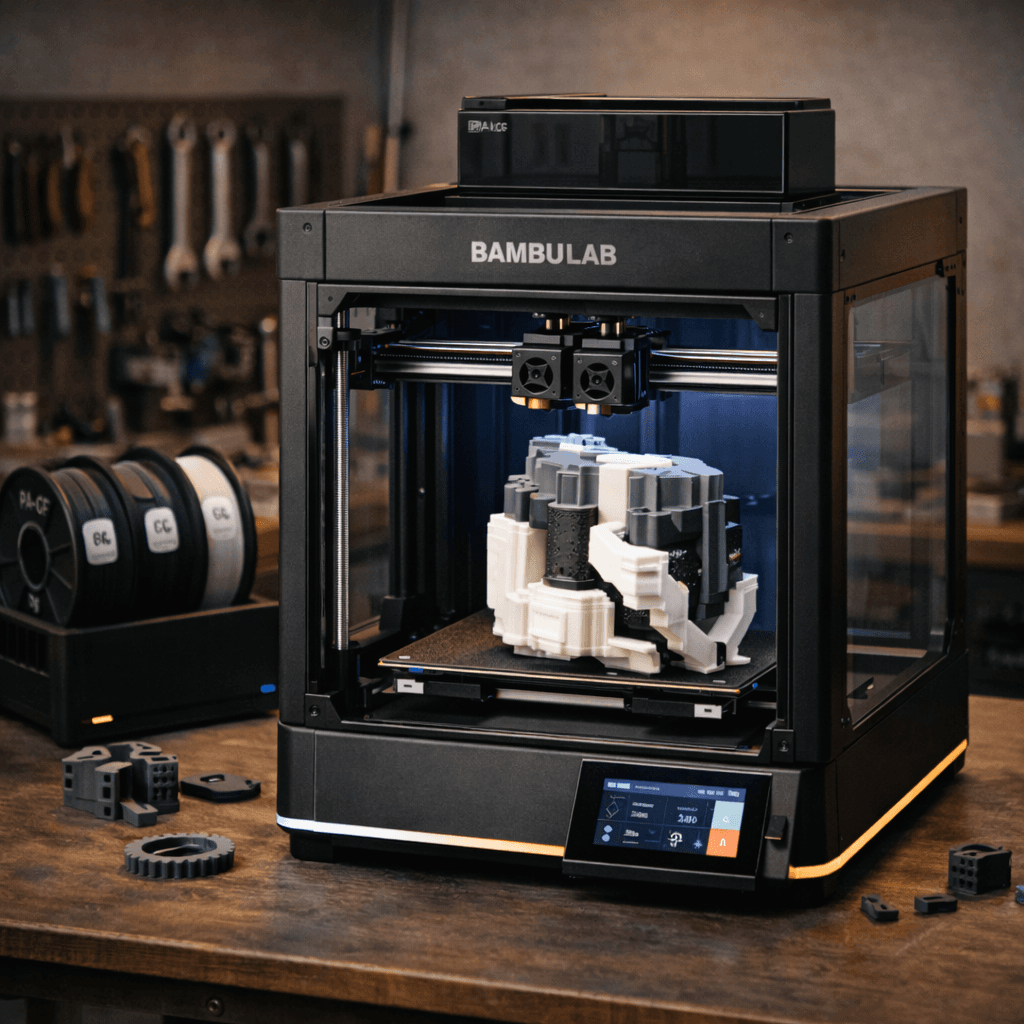
Bambu Lab P1S
$449, PrintPick score 9/10. Check the live price before it moves.
Bambu Lab P1S
Best Overall for Small Business, Score: 9/10, $449
The Bambu Lab P1S at $599 is the default recommendation for 3D printing businesses. The reason is simple: it's the most reliable printer at this price with the best infrastructure for unattended operation. The built-in camera lets you monitor prints from your phone anywhere. Essential when printers are running overnight or while you're with a client. AI failure detection can pause prints automatically when it detects spaghetti or adhesion failures, which saves filament and prevents the printer from printing into a failure for hours. The enclosed chamber handles ABS, ASA, and PETG reliably. AMS compatibility means you can run multi-color and multi-material jobs for complex commissions. Most print farm operators who run at scale use Bambu printers, specifically the P1S. That's the market's revealed preference, and it reflects real operational experience. At 500mm/s working speed, the P1S produces roughly 3-4 times the daily output of a printer running at 150mm/s. Across a week of business operation, that's the difference between fulfilling 20 orders or 80 orders. The case for buying 2-3 P1S units rather than one expensive premium printer is compelling: redundancy means one machine being serviced doesn't halt your entire business. Start with one, prove the revenue model, then scale.
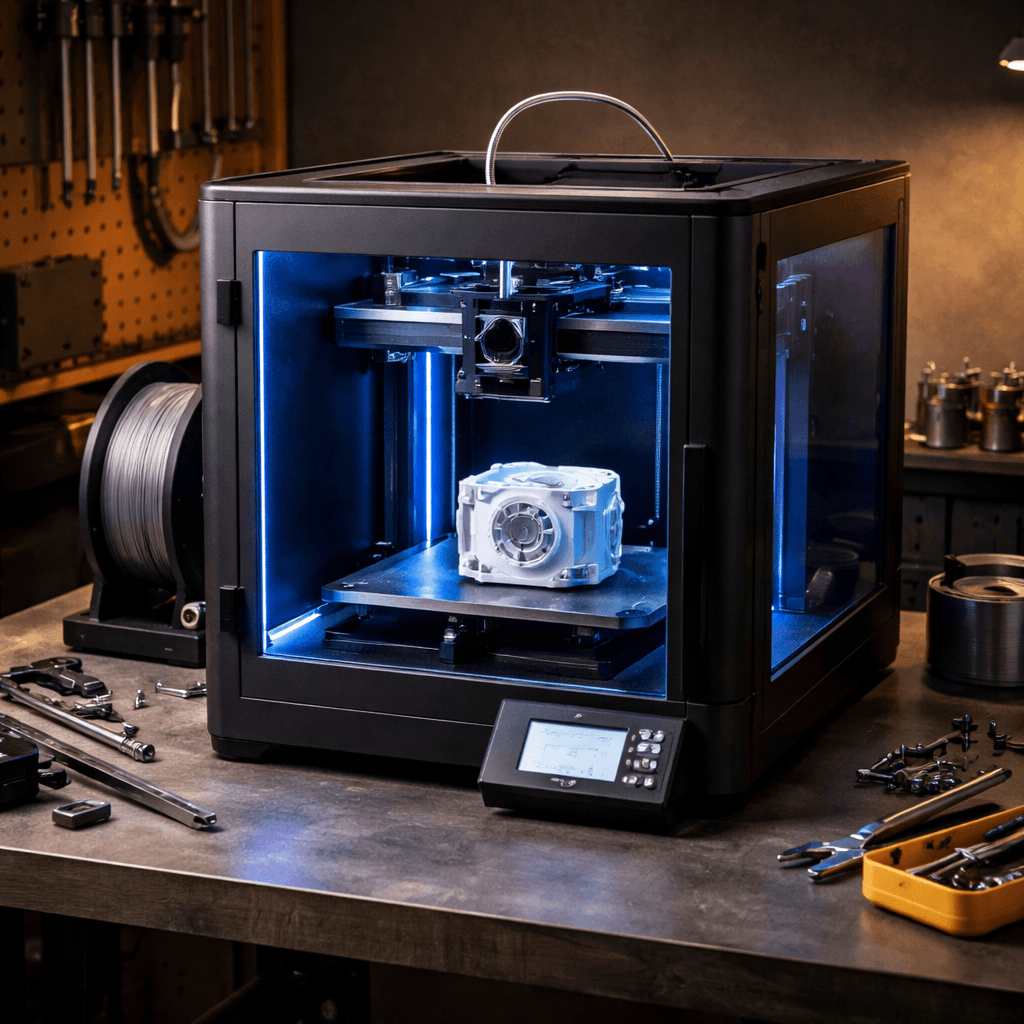
Bambu Lab H2D
Best for Engineering and Prototyping Services, Score: 8.2/10, $1899
If your business involves functional parts, engineering prototypes, or clients who need abrasive materials like carbon-fiber PLA, glass-filled Nylon, or Polycarbonate, the H2D at $1,899 justifies its premium over the P2S in direct cost savings and throughput. Dual hardened steel nozzles are the key difference. They handle carbon fiber, glass-filled filaments, and abrasive composites without degrading, and they enable support-material prints without purge waste, cutting print times nearly in half for complex parts. The 65C actively heated chamber means engineering-grade materials like PA-CF, PC, and high-temp Nylon print without warping. AI camera monitoring catches failures before they waste hours of machine time. Crucial for production workflows. The H2D's 325x320x325mm build volume is the largest in Bambu's lineup. Larger prototypes print in one piece. For businesses charging by the print, dual nozzles, heated chamber, and large build volume directly improve margins through higher throughput and fewer failed prints. If material capability and turnaround speed are your business differentiators, the H2D is the machine to beat. At $1,899, it's the right second investment after establishing revenue with a P2S fleet.
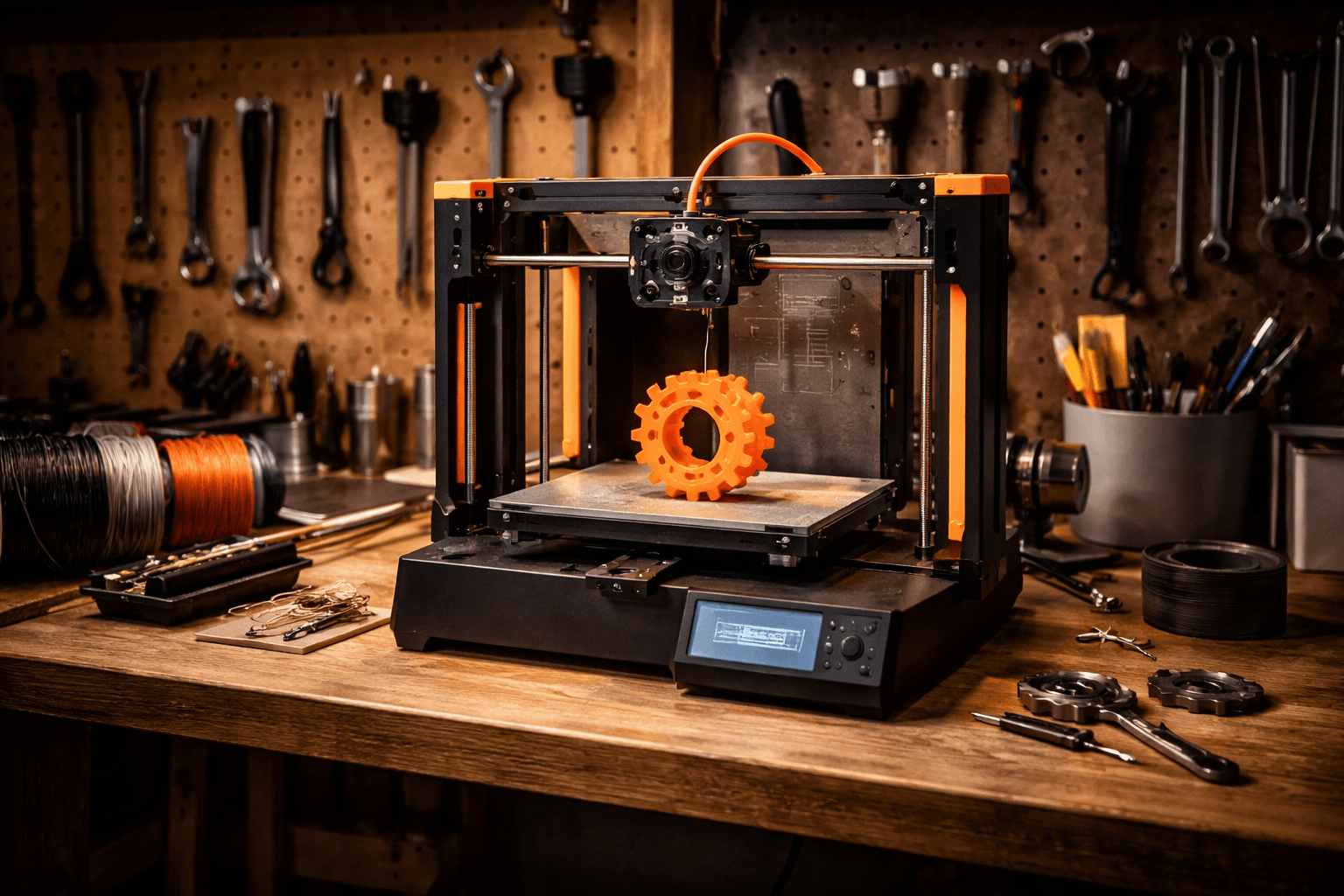
Prusa MK4S
Best for Long-Term Serviceability, Score: 7.8/10, $929
The Prusa MK4S at $799 is the choice for businesses where longevity and repairability matter more than peak speed. Prusa Research has been making printers since 2012 and provides parts, firmware updates, and support for machines years after initial release. That track record matters for a business investing in equipment expected to run 3-5 years. The MK4S is fully open source. Firmware, hardware designs, and PrusaSlicer are all on GitHub. The community actively maintains and improves the platform. You're never dependent on a single company's continued interest for software support. Replacement parts are available directly from Prusa and from third-party suppliers. The repair process is well-documented with official guides. In practical business terms: if a P1S has an unusual hardware failure, you're waiting for Bambu support. If an MK4S fails, you can typically diagnose and fix it yourself in a few hours using community resources and $15-50 in parts. The MK4S runs at 200mm/s practical speed. Significantly slower than the P1S. Where a P1S produces 4 prints in 8 hours, an MK4S produces 1-2. For businesses where part quality and long-term reliability matter more than volume, prototype engineering, medical device components, architectural models, the Prusa's track record and serviceability justify the speed penalty.
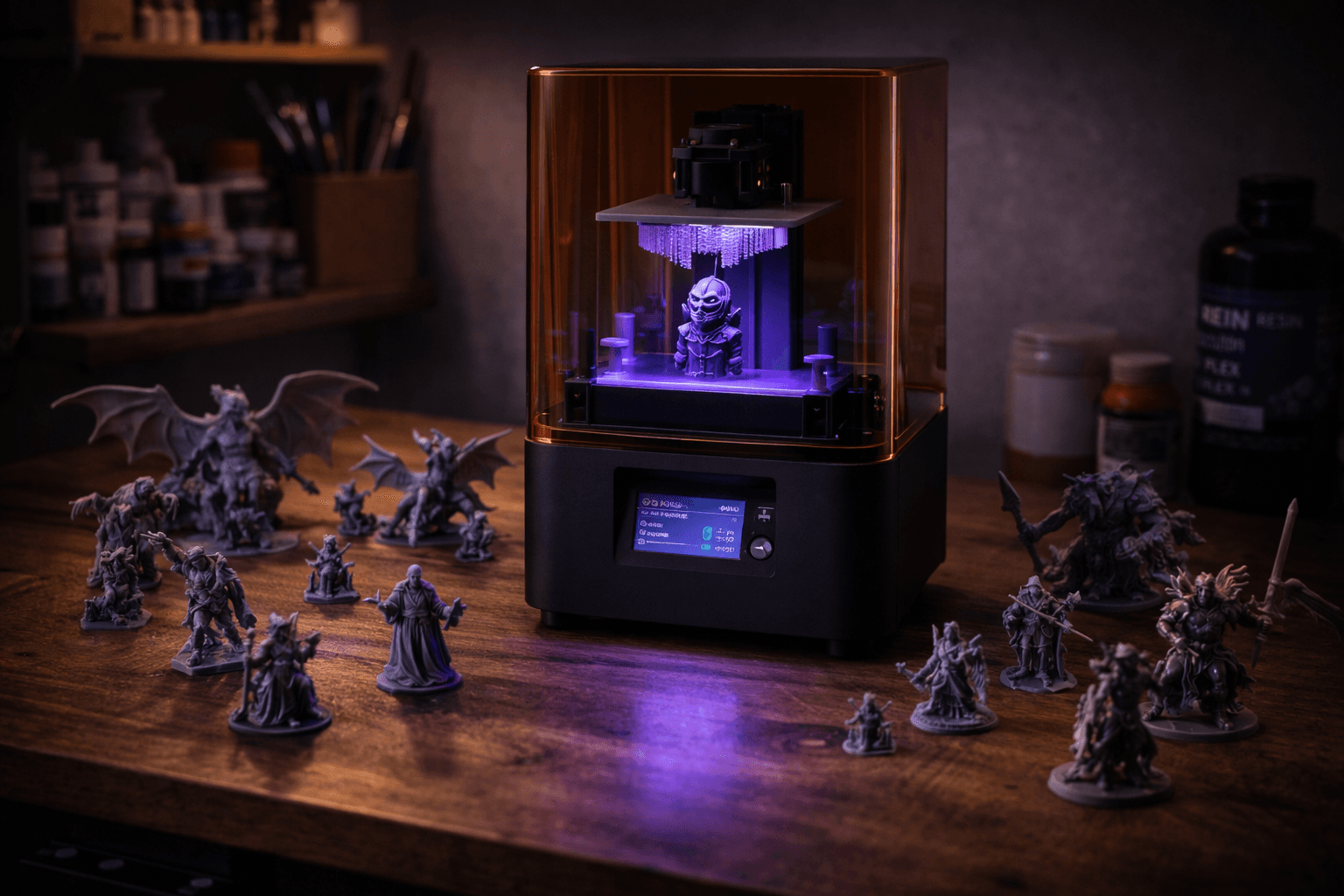
Elegoo Mars 5 Ultra
Best for Miniatures and Jewelry Business, Score: 8.2/10, $284
If your business is custom miniatures, tabletop terrain, jewelry prototyping, or dental models, the Elegoo Mars 5 Ultra at $284 is the production platform that makes the economics work. The margins on resin-printed miniatures are exceptional. A 28mm tabletop miniature uses approximately 3-5ml of resin, costing $0.09-0.25 in material at $30-50/liter. It sells for $10-25 on Etsy or $15-50 for custom commissions. That's a 95%+ gross margin on material cost. A single print run fills the 153x77mm build plate with 4-6 miniatures in 2-3 hours, producing $40-150 of sellable product per batch. Three batches per day is $120-450 in product for $1-3 in resin cost. For jewelry prototyping, the economics are similarly compelling. Casting masters for rings and pendants cost $0.15-0.50 per piece in resin and sell for $30-100+ as finished cast pieces. The 14K resolution and tilt release keep failure rates low. Professional resin printers in commercial settings run at 90%+ success rates. Wasted resin is minimal. The scaling path is straightforward: start with one Mars 5 Ultra, prove revenue, add a second to double throughput. At $284 per unit, adding capacity is cheap. Initial infrastructure (wash-and-cure station, resin supplies, ventilation) adds $200-300 in setup costs. One-time investments. The limiting factor for a miniature business isn't equipment. It's design time and marketing.
The Bottom Line
For most 3D printing businesses, start with two Bambu Lab P2S units rather than one expensive machine. Redundancy keeps you operational when one printer needs service, and parallel production handles larger orders. As revenue grows, add an H2D for engineering clients who need abrasive materials and dual-nozzle throughput, or a cluster of Elegoo Mars 5 Ultras for a miniature business. The principle that holds across all successful print farms: reliability and uptime are worth more than peak specifications. A printer running at 80% of peak specs 95% of the time outperforms a printer at 100% peak specs that needs constant attention.
Related Articles
Best 3D Printer Filaments in 2026: PLA, PETG, ABS & More
The filament you use matters as much as the printer. Here are the best filament brands and types for every material and budget.
Best Enclosed 3D Printer 2026: 5 Picks from $379 to $549, One Clear Winner
ABS, ASA, and nylon need an enclosure. Our picks from $379 (Flashforge Adventurer 5M Pro) to $549 (Bambu P1S), with a clear verdict for apartment use, engineering filaments, and budget buyers.
Best 3D Printers for TPU & Flexible Filament
Printing flexible filaments like TPU requires a direct drive extruder. These printers handle flex without jamming.