Bambu Lab A1 Mini
It IS Worth It If...
- Speed
- 500 mm/s
- Score
- 9.2/10
- Build
- 5.8 L
Check price on Amazon
Amazon sets the current price. Check it on Amazon before you buy.
guide · updated . Specs from the PrintPick catalog, checked 2026-09-29. Scores are PrintPick ratings out of 10.
By Shadman Rahman · Prices checked
It IS Worth It If...
Amazon sets the current price. Check it on Amazon before you buy.
Buy the A1 Mini. Top score of the 3 here.
A 3D printer is worth it if you're the kind of person who fixes things, makes things, or solves problems with your hands. It's a tool that's never been more affordable or reliable. If you're on the fence, start with a Bambu A1 Mini. Use it for a month. If you find yourself constantly thinking of things to print, upgrade. If it collects dust after the novelty wears off, you're out the price of the printer, which is less than most hobby investments. You'll know within 30 days. The worst-case scenario in 2026 isn't wasting money on a bad printer. It's never trying because you overthought it.
Same scale within each chart. Teal is the best of the 3.
| A1 Mini | 9.2/10 (best) | |
|---|---|---|
| Prusa MK4S | 7.8/10 | |
| P1S | 9/10 |
| A1 Mini | 5.8 L | |
|---|---|---|
| Prusa MK4S | 11.6 L | |
| P1S | 16.8 L (best) |
| A1 Mini | 500 mm/s (best) | |
|---|---|---|
| Prusa MK4S | 200 mm/s | |
| P1S | 500 mm/s (best) |
I get this question a lot. The answer isn't about whether the technology is ready. Printers in 2026 are genuinely good, faster and cheaper than two years ago. The question is whether it fits how you actually spend your time. I'm going to give you the honest version: who should buy one, who shouldn't, what it really costs, and what the first year actually looks like.
You enjoy making things with your hands. You have specific projects in mind, cosplay helmets, D&D miniatures, replacement parts for broken household items, custom phone cases, prototype enclosures for electronics, or unique gifts that you can't buy in a store. You're patient enough to learn a new skill, there's a 5-10 hour learning curve before you're comfortable. You'll actually use it more than twice a month. With a Bambu Lab A1 Mini, the barrier to entry is lower than it has ever been. For parents, a 3D printer is one of the best STEM investments you can make. Kids as young as 8 can design models in TinkerCAD and watch them materialize. Schools are adopting 3D printers by the thousands. For hobbyists, the creative possibilities are genuinely endless, there are over 5 million free 3D models on Thingiverse and Printables right now. For homeowners, a 3D printer pays for itself in replacement parts alone. Broken appliance knob? Print one for $0.15. Custom shelf bracket? $0.30. Drawer organizer perfectly sized for your kitchen? $0.50. The value compounds over time as you develop the reflex to think 'I could print that' instead of 'I need to buy that.'
You just want one specific thing printed. If you need a single item, use a print-on-demand service like Craftcloud, PCBWay, or a local maker space. You'll pay $5-30 for the part and skip the printer investment. The math only works when you print regularly. You expect it to work like a paper printer. Modern printers are dramatically more reliable than 5 years ago, but they're not appliances yet. Prints occasionally fail. Supports need to be removed. Some models require orientation adjustments. You'll spend time learning, and that time has to be enjoyable for you, not just a means to an end. You don't enjoy troubleshooting. Even with the best printers, you'll eventually encounter stringing, layer adhesion issues, or a clogged nozzle. These are solvable problems, but they require patience and willingness to debug. If you get frustrated when things don't work perfectly on the first try, a 3D printer will annoy you. You think you'll save money on household items. A plastic spatula costs about $3 in a store. 3D printing one takes $0.20 in filament but 45 minutes of print time plus design time. Injection-molded mass-produced goods are almost always cheaper. The value of 3D printing is in custom, one-off, or niche items, not in replacing things Amazon sells for $5.
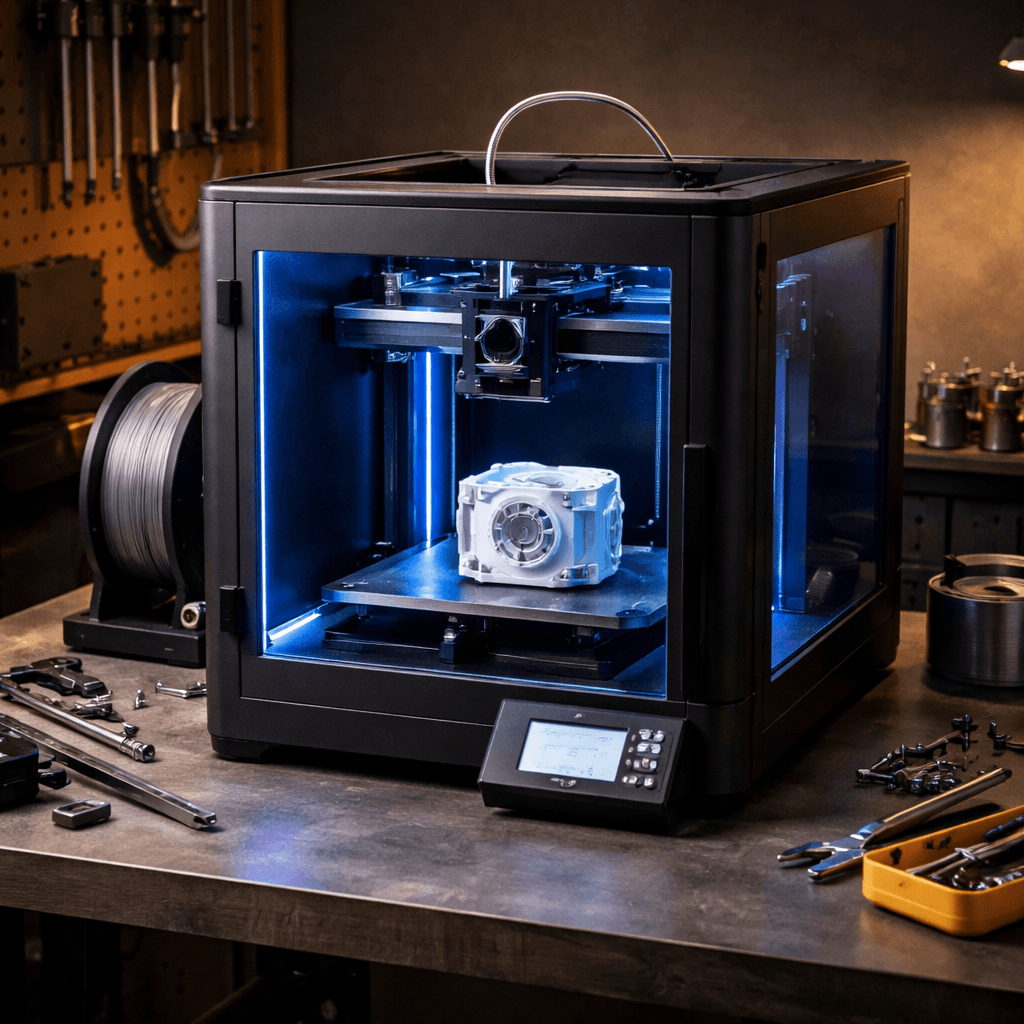
The sticker price is just the start. Here's what the first year actually costs for a typical hobbyist who prints 2-3 times per week. Printer: $199-599 depending on model. Filament: $15-25 per 1kg spool, most users go through 1-2 spools per month = $180-600/year. Replacement nozzles: $5-15 every 3-6 months. Build plate replacement: $15-25 per year. Electricity: $0.05-0.15 per print (negligible). Tools: flush cutters, scraper, deburring tool, digital calipers = $30-50 one-time. Total first year: $450-1300 all-in, depending on how much you print and which printer you buy. The ROI calculation: a typical replacement part from Amazon costs $10-30. The 3D printed equivalent costs $0.50-2 in filament plus 10 minutes of your time. Print 15-20 replacement parts and the printer has paid for itself in savings alone. Custom items you couldn't buy at any price (personalized gifts, exact-fit organizers, prototype parts) add value that's harder to quantify but very real. If you start selling prints, the ROI accelerates dramatically. Custom miniatures sell for $15-50 each at a cost of $0.20-0.50. Cosplay commissions average $200-800 for a finished helmet or prop. Print farm operators running 3-5 printers report $500-2000/month in side income. A 3D printer won't make you rich, but it can absolutely pay for itself and then some.