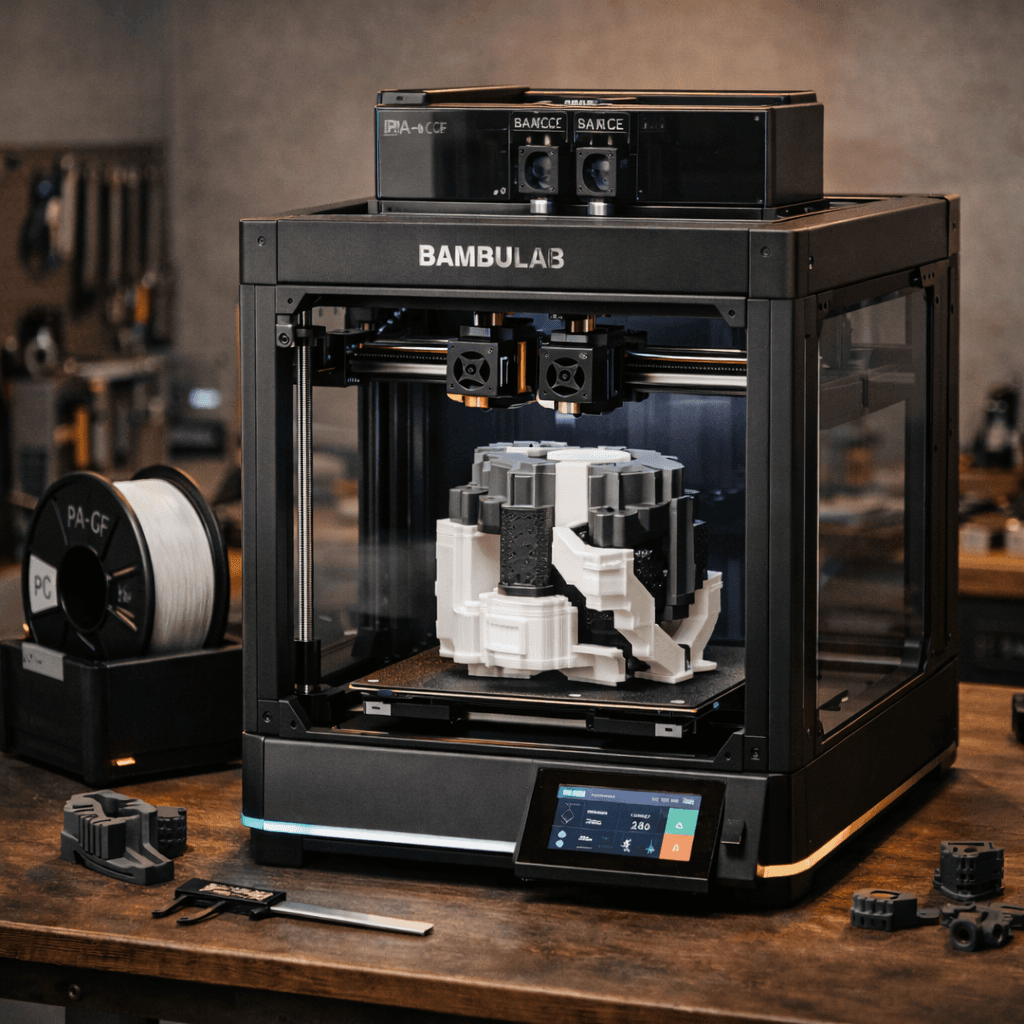
Bambu Lab P2S
Bambu Lab P2S ($549)
- Price
- $549
- Score
- 9.2/10
- Build
- 16.8 L
Buy at 3DJake
US price in USD, approximate. Your price at checkout can differ by store and country.
comparison · updated . Specs and US prices from the PrintPick catalog, checked 2026-09-29. Scores are PrintPick ratings out of 10.
By Shadman Rahman · Prices checked
Bambu Lab P2S ($549)
US price in USD, approximate. Your price at checkout can differ by store and country.
Buy the P2S. Top score of the 2 here.
Buy the P2S if: value matters, you want the best feature set per dollar, and Bambu's software ecosystem works for you. The $549 price is hard to argue with for what you get. Buy the Prusa Core One if: you value open source, need active chamber heating for demanding engineering materials, want a printer backed by 14 years of support history, and don't mind paying a premium for long-term repairability. The price gap is significant, $549 vs $1,199, and for most users the P2S delivers 90% of the capability at 46% of the price. But that last 10% (active heating, open-source, Prusa support) is non-negotiable for some.
Same scale within each chart. Teal is the best of the 2.
| P2S | $549 (best) | |
|---|---|---|
| Prusa Core One | $1,199 |
| P2S | 9.2/10 (best) | |
|---|---|---|
| Prusa Core One | 8.2/10 |
| P2S | 16.8 L (best) | |
|---|---|---|
| Prusa Core One | 14.8 L |
| P2S | 500 mm/s (best) | |
|---|---|---|
| Prusa Core One | 500 mm/s (best) |
This is the debate that splits the 3D printing community in 2026: Bambu Lab's polished, fast, feature-packed P2S vs Prusa's first CoreXY, the enclosed, open-source Core One. Two different philosophies at two very different price points. The P2S represents Bambu's value play, speed, quick-swap nozzles, AMS 2 Pro compatibility, all at $549. The Core One represents Prusa's evolution, finally moving to CoreXY with active chamber heating, open-source firmware, and legendary support at $1,199. Both are enclosed CoreXY machines. Both handle engineering materials. But one costs less than half the other.
The P2S is Bambu Lab's successor to the beloved P1S and arguably the best value in enclosed CoreXY printing today. The CoreXY motion system hits 500mm/s with input shaping. The quick-swap nozzle system lets you change between 0.2mm and 0.8mm nozzles in seconds, no tools, no downtime. The 1080p AI camera monitors prints and catches failures before they waste hours of filament. The 5-inch touchscreen is a major upgrade over the P1S's small display. AMS 2 Pro compatibility adds multi-color printing with built-in filament drying. At $549, the P2S undercuts the competition significantly while delivering enclosed printing, HEPA filtration, and engineering material capability. The downsides are real: no LiDAR (reserved for higher-tier models), the ecosystem is proprietary, and the community has raised legitimate concerns about data collection and cloud dependency. But for the price, the feature set is unmatched. Best for: anyone who wants the best enclosed CoreXY under $600 without compromise on speed, software polish, or material capability.
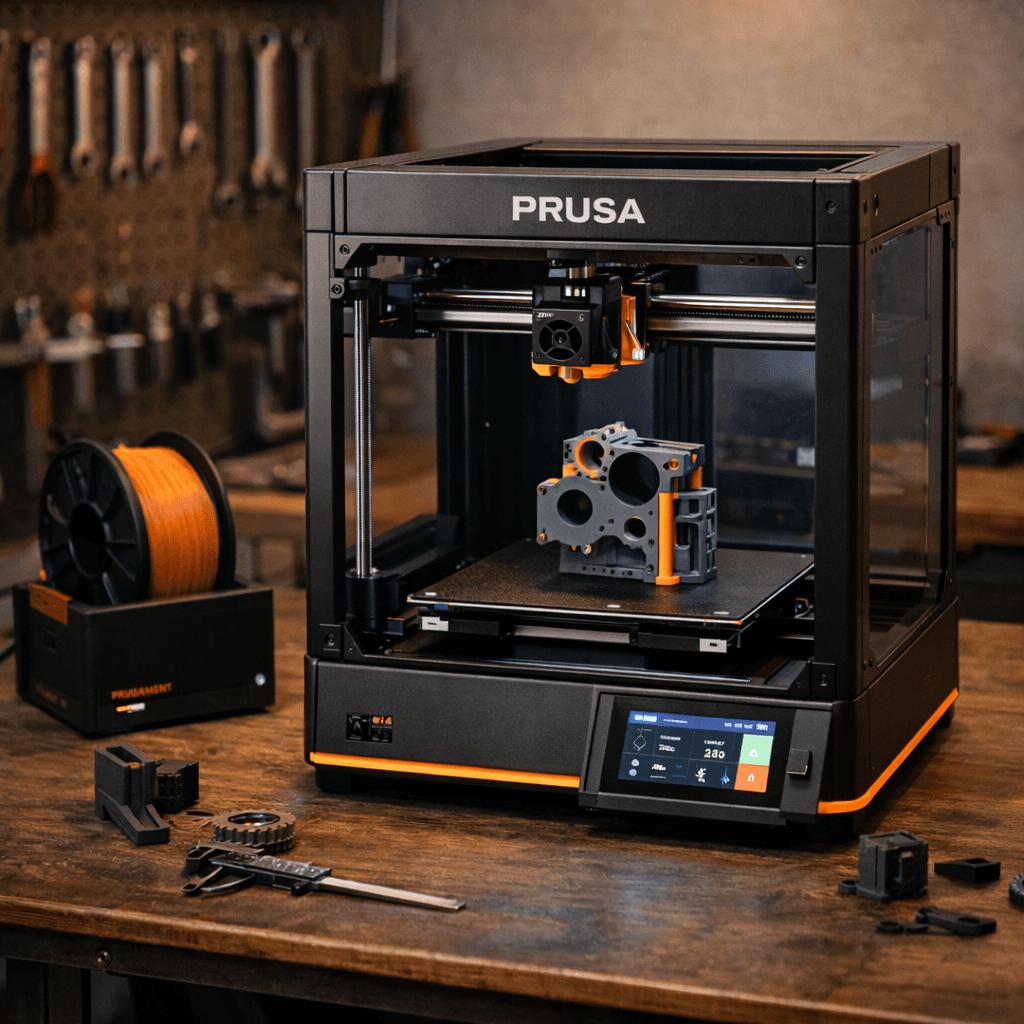
The Core One is Prusa's first CoreXY, and it was worth the wait. Active chamber heating to 55C (not passive like Bambu's models) enables reliable Nylon and Polycarbonate printing. The Nextruder direct drive with 10:1 planetary gearing delivers excellent extrusion consistency across all materials. The 360-degree cooling duct is a design innovation that improves overhang quality. Prusa's legendary open-source approach means hardware designs, firmware, and PrusaSlicer are all on GitHub. The community fixes bugs, adds features, and creates modifications. Customer support is legendary, live chat with actual printer users. The print quality is outstanding, with dimensional accuracy that matches or beats anything in its class. The MMU3 adds multi-material capability. At $1,199 assembled ($949 kit), the price is significantly higher than the P2S. The trade-offs: the build volume (250x220x270mm) is slightly smaller than the P2S's 256mm cube. It's heavier at 22.5kg. No AI camera or cloud monitoring. But what you get is a machine designed to be repaired and maintained for a decade, backed by a company that has been in this business since 2012. Best for: reliability-first users, open-source advocates, engineers who need active chamber heating for Nylon/PC, and anyone who values long-term repairability and support.